How the Pomodoro Timer's Round Cycle Actually Works
25 minutes of focus, a 5-minute break, repeat — except the round that earns you a long break skips the short one first. Here's the full cycle, and what changes when you adjust it.
25 minutes of focus, a 5-minute break, repeat four times, then a longer break — that's the standard description of the Pomodoro Timer, and it's close enough for most people. But the round that actually earns you the long break doesn't give you a short one first, and nothing on the page spells that out until you notice the break just didn't happen.
The full cycle: four rounds, three short breaks, one long one
With the defaults left alone, a complete cycle looks like this: Focus → Short Break → Focus → Short Break → Focus → Short Break → Focus → Long Break — then it starts over from Focus. Four Focus sessions, but only three Short Breaks between them, because the fourth Focus session hands off straight to the Long Break instead of queuing a Short Break first. It's not a bug or a missed break — the round that hits your "rounds before long break" count is specifically the one that skips it.
Changing "rounds before long break" moves the skip point
That setting (4 by default, adjustable from 1 to 12 in Settings) decides which Focus session is the one that skips its Short Break. Set it to 2 and the cycle shortens to Focus → Short Break → Focus → Long Break; set it to 6 and you get five Short Breaks spaced through six Focus sessions before the long one shows up. The rule stays the same regardless of the number — the last Focus session before a long break never gets a short one in between.
The round dots show you where you are in the cycle
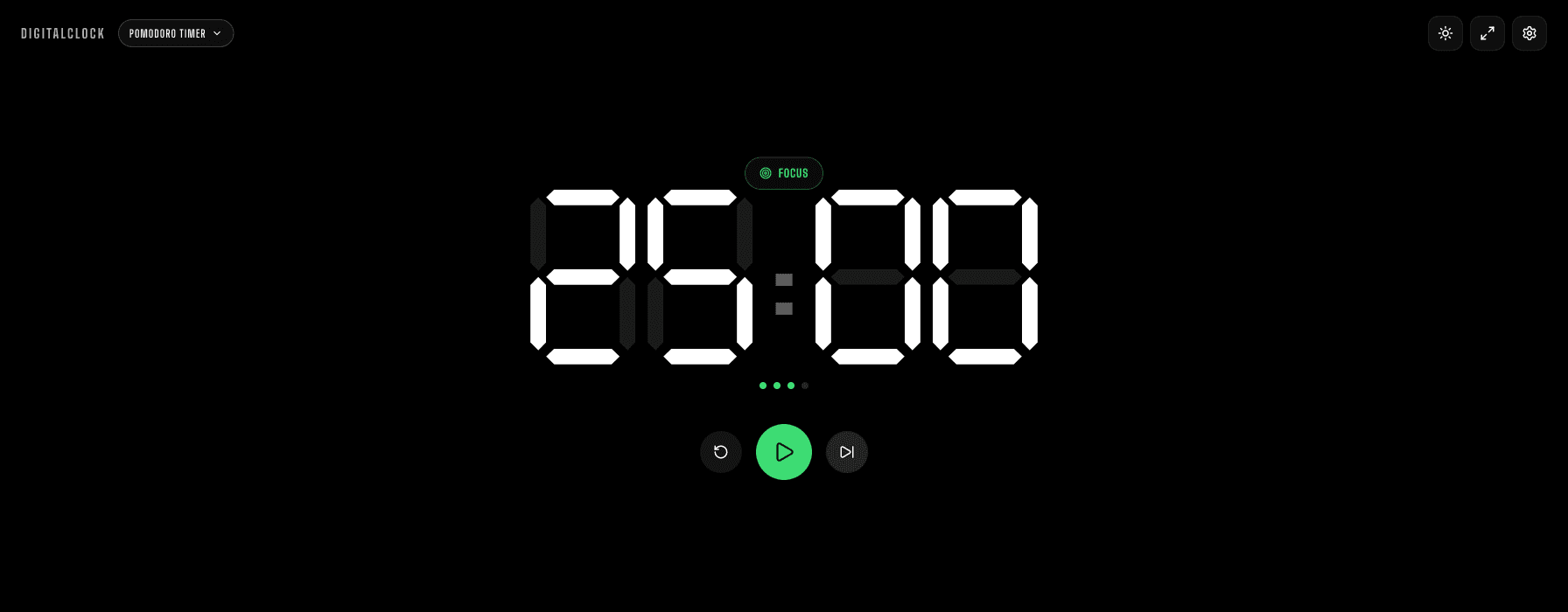
The row of dots under the countdown fills in one at a time as you complete Focus sessions, colored to match whichever phase is currently running — so a glance at the dots tells you how close the next Long Break is without doing the arithmetic yourself. Skipping ahead manually with the Skip button follows the exact same rule set, so fast-forwarding through a cycle doesn't change when the long break actually lands.
Auto-start decides whether you ever notice the cycle
With Auto-start left on (the default), every one of these transitions happens on its own — the chime plays, the phase label changes, and the countdown for the next phase starts immediately, so the skip-a-short-break rule just quietly does its thing in the background. Turn Auto-start off and the timer pauses at every single phase change, Focus or Break, waiting for you to press Start — which is really the simplest way to actually watch the cycle happen one step at a time instead of taking this explanation's word for it.