How to Read a Binary Clock in Under a Minute
Six columns, four dots each, one rule: 8-4-2-1. Here's the whole method, with a worked example against a real clock.
To read a binary clock, read each column of dots top to bottom as 8-4-2-1 and add up the lit dots — the sum is one digit of the time. Six columns give you hours, minutes, and seconds, two digits each. That's the whole method: one rule, applied six times.
The rule: 8-4-2-1
Each column of four dots represents one decimal digit, read top to bottom against the values 8, 4, 2, and 1. A lit dot means you add that value; an unlit dot means you don't. Add up whichever dots are lit in a column, and that sum is the digit.
A worked example
A single column is easy in the abstract, so here's a real screenshot of the clock to decode, dot by dot. This one was frozen at 12:45:01:
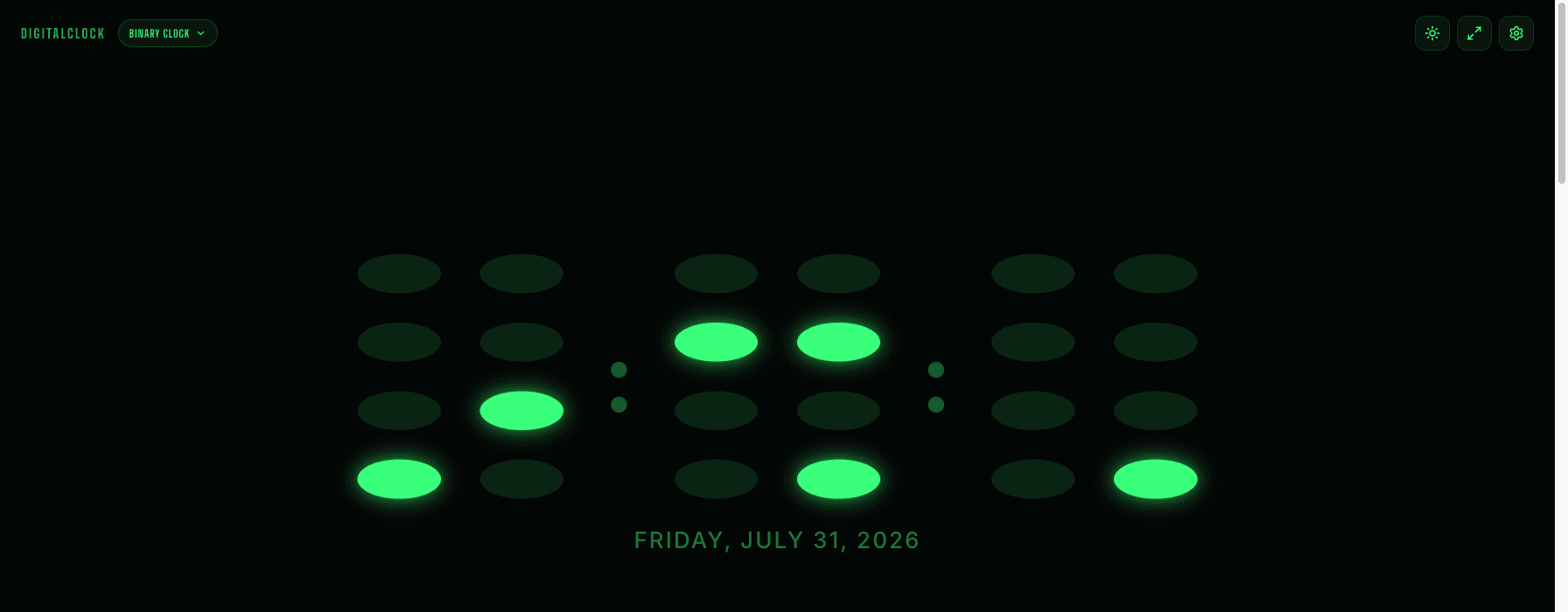
Working left to right, in pairs:
- Column 1 (hour, tens digit): only the bottom dot (1) is lit → 1
- Column 2 (hour, ones digit):only the "2" dot is lit → 2. Together, that's hour 12.
- Column 3 (minute, tens digit):only the "4" dot is lit → 4
- Column 4 (minute, ones digit):"4" and "1" are both lit → 4 + 1 = 5. Together, that's minute 45.
- Column 5 (second, tens digit): nothing lit → 0
- Column 6 (second, ones digit):only the "1" dot is lit → 1. Together, that's second 01.
Read all three pairs in order and you get 12:45:01 — exactly what the screenshot shows, arrived at one column at a time.
Putting six columns together
The clock shows six columns in a row: hour tens, hour ones, minute tens, minute ones, second tens, second ones. Read each pair together and you get HH, MM, and SS, same as any other digital clock — just arrived at one column at a time instead of printed as a font.
The fastest way to actually learn it is to leave the binary clock open somewhere you glance at anyway. You already know what time it is most of those glances, which makes it a free answer key.